
The Chair
Updated: May 28
When I was ten, I had a powder-blue chair. It was three feet in height—low enough for my feet to feel the floor; high enough for my mind to touch the sky.
The desk - the master- was flat, like the sky. Creamy painted clouds floated on its surface. A rose-pink plastic container stood like a lighthouse on its corner. It was home to my collection of pencils.
The chair always knew its place.
It was in a committed relationship with a matching blue desk. It always stood in its appointed space, organized and contained beneath its master.

A portal of authority
Every night, after dinner and the 8 pm TV serial, I occupied my chair like an army general, and assessed my pencil country.
The container held five red Natraj pencils. They stood upright like young Turks - black stripes running across their gleaming uniforms. The floral Camelins were in perpetual bloom - pink flowers scattered across a meadow of white. Then, there were pencils that had traveled from Europe and other foreign lands – fashionable diplomats decorated with stars, bells, and baubles.
My Pencil Collective also had representatives from local unknown brands - mostly a middle-aged, work-worn bunch that had lost height and color from daily wear and tear. They stood on the fringes of their country - their ends chewed up from years of holding me through exam anxiety and despair.
Every evening, as the chief commander of my Pencil Nation, I grabbed the Natraj warriors and stuck them into the mouth of my imported yellow sharpener. I turned every pencil slowly and deliberately against the double-edged blades of the sharpener till their rough edges were shaved into shining black tips.
This was preparation for war.
Only when the tips of my pencils resembled the peaks of Mount Everest would I secure them in my pencil box for travel to school the next day. My pencils were my warriors trained to win multiple unit-test battles.
After the war prep, I ran my loving gaze on the other beauties, before deciding to secret them away from the world’s gaze. My exotic imported pencils had to stay safe at home in the rosy container, lest they got grabbed and assaulted by the rowdies in school.
The chair was my portal of authority from where I chose the pencils that would step out of our home for work, and those that would be confined to their room.
At ten, I was learning to claim my chair like Dadaji (my paternal grandfather). He occupied the giant sofa in the drawing room every evening, fingers on his temples, forehead creased in frowns, listening broodily to the news on TV even as he plotted ruling-class strategies for his hapless subjects.
We were his pencils, which got shaved and trimmed every day for his perfect script.

A shift in location
One day, my blue chair toppled and cracked its ankle. The carpenter bandaged its tears with superglue and held its legs in splints. Mummy went on to place the chair in the gap between two bookshelves. The sides of the bookcases would support my fractured seat of power till it healed.
For the next two weeks, I pulled thick books from the shelves and tucked them around the chair’s broken ankles as a makeshift cast. And then, I proceeded to read the books with the colourful covers
The chair found itself in a forest of books.
Uncoupled from the desk, it started to feel free. Stories gave wings to my chair. Quickly, my wounded seat turned into a flying saucer.
I now rode an Udankhatola, which took me to worlds within the folds of the books I held in my hand.
Chair and I now travelled into seen and unseen realms - homes on the banks of unnamed rivers; kitchens with clay pots and limp grain sacks; leopards wrapped on the branches of Himalayan forests; and wish-granting trees that filled the empty pots of hungry travelers.
Some days, the chair lifted me through the forests and farms of the Panchatantra. On others, it cavorted around the ghosts that hung upside down in the mangroves of the Sundarbans. It flew low into village fairs where boys and girls rode giant wheels at festivals. Once on Eid, my chair and
I walked alongside Hamid on his trek back home with his Idgah of iron tonks for Amina, his grandmother.
A portal of imagination
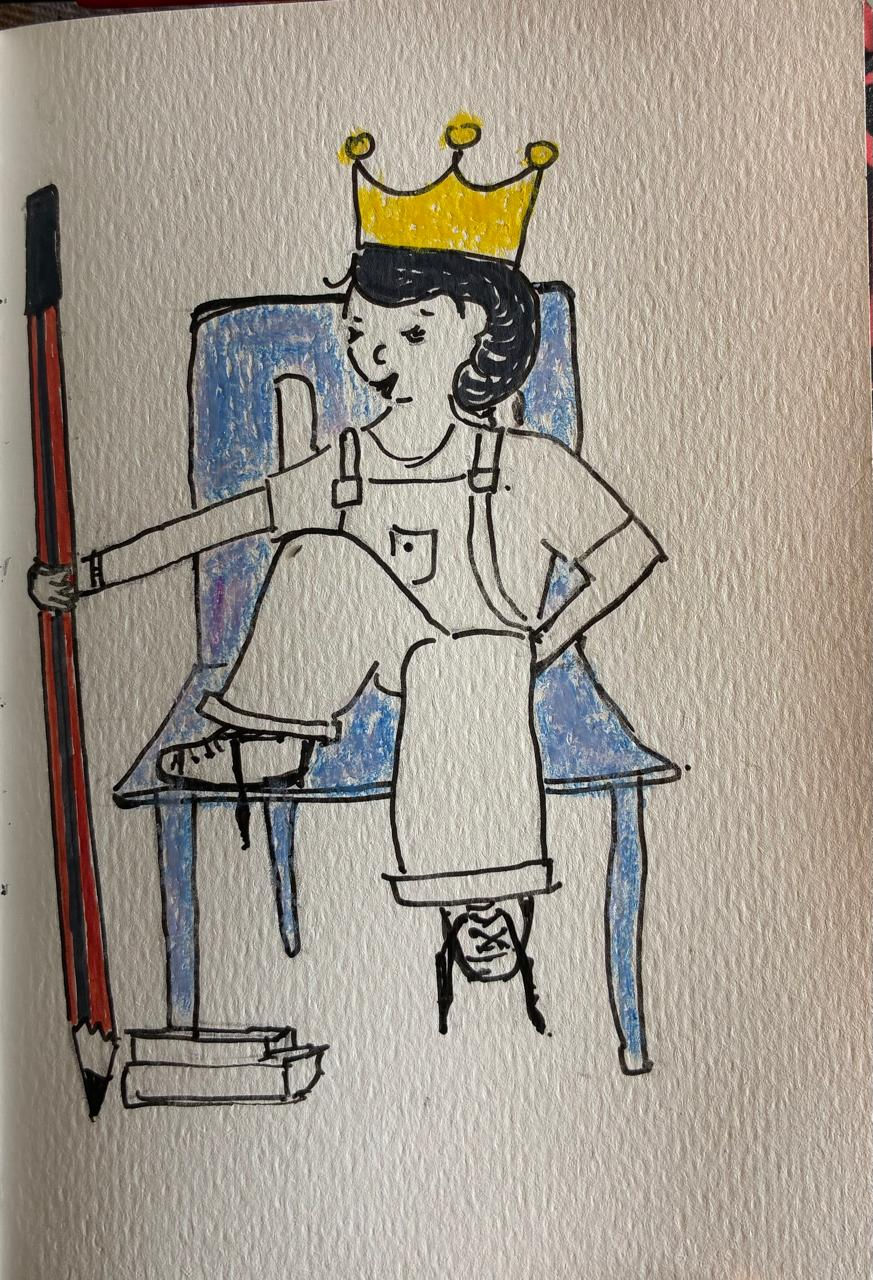
Within days, the chair became my portal of imagination - a seat of autonomy from where I could shape my land at will.
Now, every evening after dinner and the 8 pm TV serial, I claimed my chair like a boat girl bobbing on a river of stories where all characters and creatures traveled together, leaving no one behind.
The chair’s flight shifted my relationship to my pencils. Imagination gave me the courage to travel everywhere with all members of my Pencil Land. I now poured all the citizens of my Pencil country into the soft insides of a large pencil case and took all of them to school with me every day.
Travelling together turned classrooms from sites of war into lands of creative play. There were now many sentences and stories to write, each seeking the quirks of my diverse and different pencils. Plus, who wanted to win unit tests, when the bovine craziness of Mahashweta Devi’s Non-Veg Cow had me locked in laughter and the higher wonders of nonsense?
Three weeks later, the chair’s fracture healed. I refused to let Mummy move it back to the desk.
Neither chair nor I are needed masters in our lives.
From then on, my chairs and I decide our place in the rooms we occupy. We lounge, rest, serve, and command from locations that feel right to us. We break the boundaries of the spaces allocated to us. And when we fracture, we heal in forests of stories.
Chairs continue to ground me to the floor. And allow my mind to touch the sky.

This essay was written in a writing circle of Ochre Sky Stories with Natasha Badhwar in February 2026. It is now part of the Objects of our Affection (#26)
I plodded on with multiple drafts inspired by Roshni ‘s love of chairs and the beautiful ones that she and her sister create at the Thadi Store (www.thadi.store)
The illustrations for this piece here have been made by writer and artist Savvy Soumya Misra
*********
Objects of Our Affection is a series exploring our connections to the furniture and objects that make our spaces home. Through stories of tables, chairs, and that odd-shaped thing only you love, we celebrate the inanimate pieces that hold memory and witness our lives.
If you'd like to contribute your own story to this series, we'd love to hear from you. Micro-essays, poems, reflections, and fragments welcome. Write to us at hellothadi@gmail.com. Word limit 400.




Comments